

AI-assisted ecommerce operations automation: from paid order to delivered parcel
Ecommerce operations automation removes the manual order, production and fulfilment steps behind a storefront: routing, file preparation, status updates and back-office sync, with AI flagging risky orders and triaging exceptions. It suits merchants and online printers whose order volume has outgrown their staff. In delivered work, 4over4 cut design-file production time 40% and Geo-Tek cut order processing time 30%.
Review this solution for your workflow View relevant workReviewed by David (CEO) · Updated 17 Sep 2026

Design-file production time fell 40% at 4over4
Order fulfilment time fell 50% at 4over4
Order processing time fell 30% at Geo-Tek
Revenue grew 36% in the first quarter after launch
What the solution is, and where it stops
Ecommerce operations automation is a commerce back-office solution that helps operations managers move every paid order to production and delivery without re-keying, chasing files or answering "where is my order" by hand. It sits between your storefront and the systems that make, pack and ship the product.
It covers order intake, validation, file preparation, routing to production or suppliers, status updates, shipping and the sync of every change to finance and customer records. It does not redesign your storefront or checkout, which sit elsewhere in the commerce experience solutions family, and it does not replace your warehouse, presses or accounting package. It connects them.
Where order operations break today
-
- Current state
- Staff copy each order from the store into production or supplier systems
- Target state
- Orders flow into production queues automatically, with every field they need
-
- Current state
- Customer artwork and files are fixed or converted by hand
- Target state
- Files are checked and converted to production formats as the order arrives
-
- Current state
- Orders with a problem are found late, at the press or the packing table
- Target state
- Validation rules stop incomplete orders at intake and alert the right person
-
- Current state
- Customers email for status because nobody updates them
- Target state
- Status changes trigger customer notifications at each stage
-
- Current state
- Finance and customer records drift from what actually shipped
- Target state
- Every change syncs back to ERP, CRM and accounting
How the workflow runs
The workflow, step by step:
-
Order intake
A paid order arrives from the storefront, a marketplace or a B2B portal and enters one order queue.
-
Validation
Rules check addresses, product options, quantities and attached files; incomplete orders go to an exception queue with the reason attached.
-
File preparation
Customer designs and uploads are checked and converted into the formats production needs.
-
Routing
Each order line is sent to the right production team, machine group, warehouse or supplier based on product, location and capacity rules.
-
Production and status
Production updates the order as work starts and finishes; each change triggers a customer notification.
-
Fulfilment
Packing, shipping label and tracking number are generated, and the carrier status feeds back into the order.
-
Back-office sync
Invoices, stock, costs and customer history update in ERP, CRM and accounting, and the operations dashboard shows cycle times and exceptions.
Capability modules
Orders from store, marketplace and B2B channels → Normalizes them into one queue → A single list of work to do
Order data and attached files → Checks completeness and business rules → Clean orders or flagged exceptions
Customer designs and uploads → Checks and converts files → Production-ready files per order
Clean orders, capacity and location rules → Assigns each line to production or a supplier → Jobs in the right queue
Production and carrier events → Updates the order and informs the customer → Fewer status requests
Packed orders → Creates labels and tracking → Shipped orders with tracking
Order, stock and payment changes → Updates ERP, CRM and accounting → Consistent records across systems
Order events over time → Measures cycle time and exceptions → A live view of throughput

Where they fit, projects reuse modules from the Netbase productized library, chiefly the workflow automation toolkit and the e-commerce accelerator, and build the rest around your process.
AI where the rules run out
Rules handle the predictable orders. AI earns its place at the edges, where someone used to read, guess or chase, and any AI decision that touches money or a customer goes to a person first.
-
Order and payment anomaly detection
Likely fraud, duplicate charges and unusual refunds held for review before production starts.
-
Demand forecasting
Expected orders per product line and week, so capacity, stock and shifts are planned ahead.
-
Invoice and document capture
Supplier invoices, purchase orders and delivery notes read into draft records that finance confirms.
-
Support triage
"Where is my order" and complaint emails classified, answered from live order status or routed to the right person with a summary.
Models are chosen per project from commercial or open-source options, and order data reaches only the services your data terms allow.
AI in this solution
Most of this solution is rules-based workflow automation. The first two items below are delivered AI; the third is a growth capability.
-
In delivered work
Recommendation engine
Built for the 4over4 store in the same project.
-
Available capability
Order anomaly detection, demand forecasting and document capture
Machine learning and document AI that Netbase offers; not yet tied to a published order-operations case.
Integrations, data, security and deployment
-
Integrations
Netbase has delivered commerce on WooCommerce, Magento 2, Laravel and headless commerce, and works across a wider stack from Shopify and Shopware to Akeneo and Odoo. Typical connections are payment providers, carriers, production or print software, ERP, CRM and accounting. The connection work itself is delivered through our systems and API integration service, and commerce and enterprise platforms explains when each platform fits.
-
Data boundary
Orders, files, customer data and pricing stay in systems you control. Each integration contract defines which fields move, in which direction and how often, and card data stays with the payment provider.
-
Security
Reviewed at every integration boundary as it is built: secure code review, TLS in transit and AES at rest, role-based access, MFA for admin dashboards, vulnerability scanning and disaster recovery, with NDAs, DPAs and SLAs on request.
-
Deployment
The automation layer can run inside your current commerce platform, as a separate service beside it, or as part of a new custom platform, depending on order volume and how many systems it has to join.
Implementation phases, roles and support
-
Operations review
Follow real orders from checkout to delivery, count the manual touches and agree the metrics: processing time, production time, exceptions per hundred orders.
-
Blueprint
Choose the modules, integrations and rules, and agree what to automate first.
-
Build and integrate
Connect the store, production and back-office systems and write the validation and routing rules.
-
Pilot
Run a product line or a channel through the new flow, compare cycle times with the baseline and tune the rules.
-
Roll out
Extend to every channel, train staff and hand over documentation.
-
Optimize
Review the dashboard after launch and automate the next exception type.
The pilot is the lean core of the method: one product line proves the flow against the baseline before anything scales. Build work runs in Agile sprints with weekly reviews of real orders, remote-first from Hanoi in English, and every connector is API-first. A typical team combines a business analyst, a solution architect, developers and QA, with a project manager as your single point of contact. Timeline drivers are the number of systems to connect, the quality of existing order data and how many product types need their own rules.
Configuration, customization, IP and lock-in
-
Configured
Validation rules, routing rules, notification templates, status stages and dashboard views.
-
Customized
File conversion logic, connectors to your production and supplier systems, and any rule that encodes how your business actually runs.
-
Ownership
You own the IP Netbase creates for your custom development. Netbase productized modules and Business Division products are licensed, not transferred. Integrations use documented interfaces, so you can extend or replace any part later.
Technologies we build with








Industry variants and use cases
Online printing and web-to-print
Netbase has delivered 50+ custom web-to-print platforms across apparel, packaging, signage, promotional merchandise and corporate B2B portals. Here, file preparation and routing to presses carry most of the saving.
Retail and D2C brands
Multi-channel order intake, stock sync and carrier updates; see retail and ecommerce.
Retail and ecommerceB2B ordering
Approval steps, account pricing and scheduled reorders routed straight to fulfilment.
Work evidence and measured results
- 4over4, online printing, United States. Netbase automated the conversion of Adobe Illustrator (.ai) design files to SVG alongside checkout, search and recommendation work. As reported by 4over4 in the published case study, design-file production time fell 40% and order fulfilment time 50%, and revenue grew 82% within six months of implementation. Baselines were not published, and the results reflect all changes together. Read the 4over4 case study.
- Geo-Tek IT Solutions, printing and design services, Cyprus. Netbase built a responsive design and ordering platform and integrated it with Geo-Tek's existing systems, which had slowed digital order processing. Geo-Tek reported average order processing time down 30% and revenue up 36% in the first quarter after launch. Read the Geo-Tek case study.
See every project in our work.
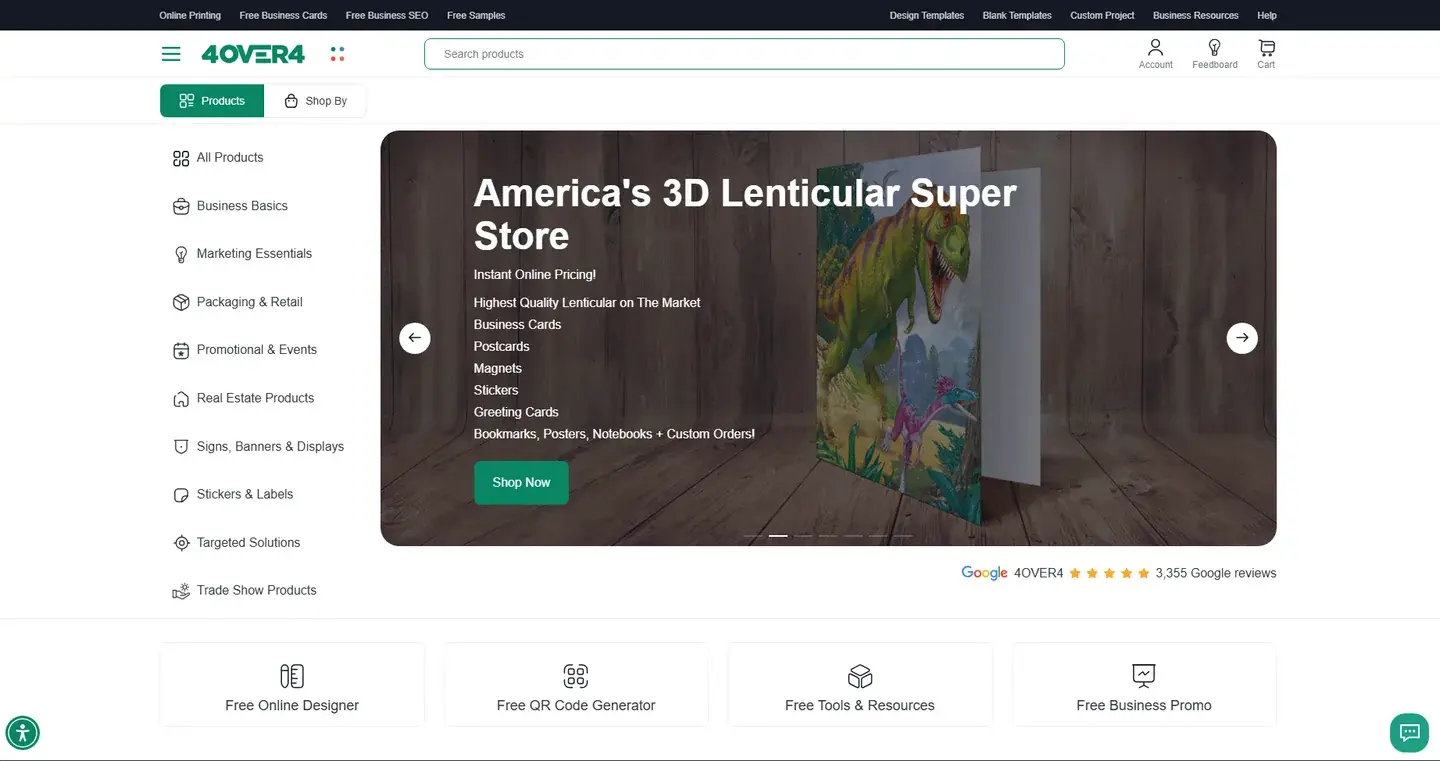
4over4, a US online printing store, had steady traffic but too few orders.
Keep Reading
Geo-Tek IT Solutions, a printing and design-services company in Cyprus, needed an online design platform that worked on every device and fitted its existing systems.
Keep ReadingFrequently asked questions
Mostly rules-based workflow automation, which is predictable and easy to audit. AI helps at specific steps, such as reading unstructured files; our guides on AI agents versus workflow automation and on AI automation for business operations explain where each fits.
No. AI holds and explains suspicious orders; a person releases, cancels or refunds them, and every decision is logged.
Usually not. The automation connects to the platform you run.
With the step that costs the most staff time per order today, usually file preparation or order re-keying.
Services behind this solution
 API integration services that keep your systems in agreement and ready for AI
Netbase provides API integration services for commerce and operations teams to connect e-commerce, ERP, CRM, shipping and payment systems so data moves once and stays correct, and AI services can act on it. We build integrations on APIs and webhooks with retries, monitoring and reconciliation, so a failed call becomes a logged, recoverable event instead of a missing order.
Learn More
Related and next step
Companion pages cover agentic AI automation, AI and data services, AI strategy and readiness and machine learning and predictive analytics; the enterprise AI readiness assessment checks whether your data and team are ready. You can also compare all Netbase solutions or view relevant work. Send us one week of order data and your tool list, and we will review this solution for your workflow.
Discuss a project
Netbase JSC helps organizations design, build, modernize, and operate digital products and AI-enabled business systems.+84 937 869 689
91 Nguyen Chi Thanh, Dong Da, Hanoi, Vietnam
Get in touch
Tell us what you want to build, modernize, or operate.