

Multi-vendor marketplace development: vendors, catalog, payouts and AI search on one platform
A multi-vendor marketplace is a commerce platform where many independent sellers list, sell and get paid through one storefront. Netbase's marketplace solution covers vendor onboarding, a shared catalog, split payments and payouts, with AI for search, listing enrichment and fraud checks. For an EU fashion-tech marketplace, Netbase's work grew gross merchandise value (GMV) 47% and cut vendor onboarding time 60%.
Review this solution for your workflow View relevant workReviewed by David (CEO) · Updated 17 Sep 2026

GMV grew 47% for an anonymous EU fashion-tech marketplace
Vendor onboarding time fell 60% on the same marketplace
What a marketplace platform does, and where it stops
A marketplace platform helps marketplace founders, e-commerce directors and retail groups grow a catalog without owning the stock. The operator sets the rules, vendors bring products, and buyers get one place to discover, compare and buy. It suits mid-market enterprises adding a marketplace to an existing business, and agencies and technology partners building one for a client.
The solution covers the operator back office, the vendor portal, the buyer storefront and the money flow between them: onboarding, catalog, orders, commission, payouts, returns and reporting. It does not replace your vendors' own warehouses, carriers or accounting systems. It connects to them, and it gives each party exactly the data it needs.
It belongs to the commerce experience family, next to web-to-print and product personalization.
From spreadsheet vendor management to a scalable marketplace
-
- Current state
- Vendors onboard through emails, forms and manual checks that take weeks
- Target state
- Guided self-onboarding with verification and clear approval rules
-
- Current state
- Every vendor describes products differently
- Target state
- A shared catalog with required attributes and moderation
-
- Current state
- Mixed carts are split and invoiced by hand
- Target state
- Orders split per vendor automatically at checkout
-
- Current state
- Commission and payouts calculated in spreadsheets
- Target state
- Commission rules and scheduled payouts run by the platform
-
- Current state
- Returns and disputes handled over email
- Target state
- Tracked returns, disputes and reviews in one workflow
-
- Current state
- No clear view of GMV, vendor performance or margin
- Target state
- Operator dashboards for GMV, vendors, orders and payouts
The marketplace workflow, step by step
The workflow, step by step:
-
Apply
A vendor signs up and submits business details.
-
Verify
The operator checks the vendor and approves the account, with rules that can be automated.
-
List
The vendor adds products that map to the shared catalog attributes; moderation rules catch incomplete or off-brand listings.
-
Discover
Buyers search, filter and compare products across vendors.
-
Buy
One checkout takes payment for a cart that can hold products from many vendors.
-
Split
The platform splits the order into vendor sub-orders and calculates commission.
-
Fulfil
Each vendor ships its part and posts tracking; the buyer sees one order status.
-
Resolve
Returns, disputes and reviews run through a defined workflow.
-
Pay out
Vendor balances, minus commission and refunds, are paid on schedule.
-
Report
The operator tracks GMV, vendor performance and payouts.
Capability modules
Vendor applications, documents → Guides sign-up, verification and approval → Approved, active vendors
Products, stock, orders → Lets vendors run their shop → Up-to-date listings and fulfilled orders
Vendor listings → Enforces attributes and quality rules → Consistent, searchable catalog
Catalog data, buyer queries → Ranks and filters across vendors → Relevant results and comparisons
Mixed carts → Splits orders per vendor → Vendor sub-orders with one buyer view
Paid orders, commission rules → Calculates fees and balances → Scheduled vendor payouts
Vendor locations, carriers → Applies rates and tracking → Accurate delivery options and status
Buyer requests → Routes cases to vendor and operator → Resolved cases and trusted ratings
All marketplace data → Consolidates metrics → GMV, vendor and payout dashboards

AI a marketplace operator can put to work
Operators now expect a growing catalog to stay findable and trustworthy without a new moderator for every hundred vendors. AI does the first pass; the operator's rules and staff make the call.
-
AI search and ranking
Intent-aware search across every vendor's listings, with ranking rules the operator controls.
-
Listing enrichment
Missing attributes, titles and descriptions drafted from vendor data and product images, held for moderation.
-
Vendor onboarding checks
Business documents read and matched against the application; an operator approves every vendor.
-
Fraud and anomaly detection
Unusual orders, refund patterns or payout-detail changes flagged before money moves.
-
Review moderation
Fake or abusive reviews flagged, with a person deciding what comes down.
Vendors see AI output only for their own listings, and models are chosen per project, so buyer and vendor data reach only model services that meet your data terms.
AI in this solution
What Netbase has delivered with AI in commerce, and what it offers as a growth capability.
-
In delivered commerce work
A recommendation engine
Built for 4over4's online printing store, not for a marketplace.
-
Available capability
AI search, listing enrichment and fraud signals
Machine learning, NLP and computer vision that Netbase offers; not yet tied to a published marketplace case.
Integrations, data, security and deployment
Netbase has delivered commerce on WooCommerce, Magento 2, Laravel and headless architectures, and works across a wider stack including Shopify, PrestaShop, OpenCart, Shopware, CS-Cart, Salesforce, Akeneo, Odoo and Symfony. A marketplace typically connects payment providers that support split payments, carriers, tax services, a PIM such as Akeneo, an ERP such as Odoo and CRM. Our systems and API integration service builds those connections; see commerce and enterprise platforms for the stack trade-offs and marketplace platform architecture for payments, vendors and scale.
-
Data boundary
The operator owns platform and buyer data. Each vendor sees only its own products, orders and payouts, and receives buyer details only as far as fulfilment needs them. Card data stays with the payment provider.
-
Security
Designed into payment and payout flows from the blueprint: secure code review, TLS in transit and AES at rest, role-based access, MFA for admin dashboards, vulnerability scanning and penetration testing, and disaster recovery, with NDAs, DPAs and SLAs on request.
-
Deployment
Extend a WooCommerce or Magento 2 store with marketplace capability, build a custom Laravel marketplace, or run a headless storefront on a separate commerce core. For marketplaces that must plug into ERP, CRM and data platforms, see enterprise platforms. Moving off an ageing store first? Legacy modernization and the digital transformation and modernization guide cover the replatforming path.
Implementation phases, team and support
-
Discovery
Marketplace model, vendor journey, commission logic, payment flow and KPIs.
-
Blueprint
Platform choice, data model, integrations and release plan.
-
Build
Vendor, buyer and operator modules delivered in milestones through e-commerce development.
-
Integrate and test
Payments, payouts, carriers and full order runs with test vendors.
-
Launch
Pilot vendors first, then open onboarding.
-
Scale
Performance, new vendor tools and data-driven improvements.
The approach is lean: the pilot vendor group is the first measurable release, and later sprints follow what it shows. Sprints end in a weekly demo, the team works remote-first from Hanoi in English, and the marketplace is API-first, so vendor tools, a mobile app or a PIM use the same interfaces.
Typical e-commerce timelines run 1 to 3 months for a small build, 4 to 6 months for a mid-sized one and 6 to 12 months or more at enterprise scale; the payment model, vendor count and integrations drive the timeline.
Configuration, customization and ownership
-
Configured
Commission rates, vendor tiers, categories and attributes, moderation rules, payout schedules and shipping rules.
-
Customized
Onboarding logic, order splitting, payout calculations, vendor tools and integrations that fit your model.
-
Ownership
You own the IP Netbase creates in your custom development. Netbase productized modules and Business Division products, such as CMSmart extensions, are licensed, not transferred, so you can reuse them without paying to rebuild them.
Technologies we build with








Industry variants and use cases
Fashion and lifestyle
Size and variant-heavy catalogs, fast vendor onboarding and returns at volume.
B2B wholesale
Company accounts, tiered pricing and bulk ordering across suppliers.
Custom and printed products
Vendors offer personalized goods with design and proof steps.
Regional retail groups
One storefront for many stores or brands, each with its own stock.
For the sector view, see retail and e-commerce.
Results and proof
- EU fashion-tech marketplace. After Netbase rebuilt its vendor onboarding and catalog flows, GMV grew 47% and vendor onboarding time fell 60%, as reported in the published marketplace case. The client stays anonymous. Read the EU fashion marketplace case.
- RB Marketplace. A multi-vendor marketplace for West Africa and the diaspora, with vendor approval, commissions, payouts and a customer shopping app. Read the RB Marketplace case.
- Clients not named. A bilingual classifieds marketplace with AI moderation, and a multi-vendor reward shop for a loyalty company. See the classifieds record and the reward shop record.
- Multi-vendor print stores. Store builders who chose the CMSmart multi-store theme appear in our web-to-print customer stories.
- CMSmart. The Netbase Business Division that builds and maintains the commerce extensions merchants install on their own stores, marketplace setups included. See the CMSmart portfolio record.
- Storelly. A Netbase Business Division: a D2C SaaS platform for brands that sell direct, own the customer and offer custom products, with a community of 15,000+ customers. See the Storelly portfolio record.
CMSmart, Printcart, Cloodo, Poslor and Storelly are all Netbase Business Divisions, so the teams behind your marketplace also build and run commerce products of their own.

Netbase JSC built the feature and integrated a secure payment gateway.
Keep Reading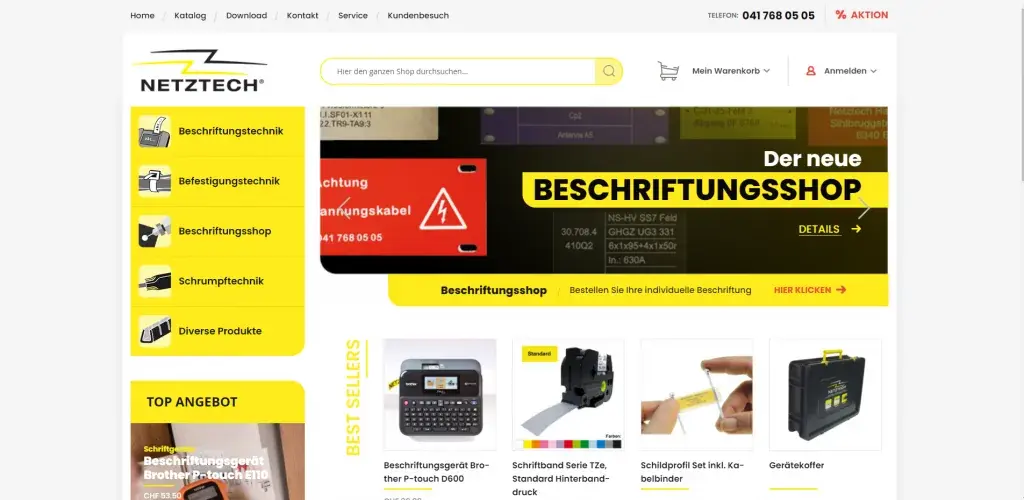
Netztech Handels AG, a Swiss supplier of labeling, fastening and shrink technology, moved its busy online store from Magento 1 Community Edition to Magento 2 Commerce with Netbase JSC.
Keep Reading
This record covers what Netbase engineers and supports, and the stack behind it.
Keep ReadingFrequently asked questions
A multi-store setup runs several shops you own. A marketplace lets independent vendors sell through your storefront, so it adds onboarding, commission, split orders and payouts.
Extend when your platform handles your vendor and payment model; build custom when the model is your competitive edge. Our custom e-commerce platform guide walks through the decision.
The platform tracks each vendor balance, deducts commission and refunds, and pays out on the schedule you set, through a payment provider that supports split payments.
No. AI checks documents, flags risky listings and suspicious orders, and drafts catalog fixes; your operators approve vendors, take listings down and release held payouts.
Yes. A pilot with a small vendor group proves the flows before onboarding opens.
Services behind this solution
 AI-enabled ecommerce development for merchants who outgrew templates
Netbase provides custom ecommerce development for merchants that have outgrown templates, to turn existing traffic into orders and run operations with less manual work, using AI for search, recommendations and catalog work where it pays. We build on WooCommerce, Magento 2, Laravel and headless stacks; 4over4, whose store gained an AI recommendation engine, reported 82% more revenue within six months.
Learn More
 API integration services that keep your systems in agreement and ready for AI
Netbase provides API integration services for commerce and operations teams to connect e-commerce, ERP, CRM, shipping and payment systems so data moves once and stays correct, and AI services can act on it. We build integrations on APIs and webhooks with retries, monitoring and reconciliation, so a failed call becomes a logged, recoverable event instead of a missing order.
Learn More
Related insights

Off-the-shelf e-commerce stops fitting when workarounds cost more than the platform saves: manual order handling, integrations held together by exports, and features the platform cannot express. Plan a custom build or replatform by choosing the architecture, mapping integrations, controlling migration risk and costing the drivers, and make the new platform expose the clean catalog and order data AI needs.
Related solutions and next step
Compare all Netbase solutions or view relevant work. Share your marketplace model and vendor plans, and we will review this solution for your workflow.
Discuss a project
Netbase JSC helps organizations design, build, modernize, and operate digital products and AI-enabled business systems.+84 937 869 689
91 Nguyen Chi Thanh, Dong Da, Hanoi, Vietnam
Get in touch
Tell us what you want to build, modernize, or operate.