

Website redesign without losing search visibility: a pre-launch audit list
A website redesign keeps its search visibility when the team records what the old site earns, sends every changed URL to its closest new page with a permanent redirect, carries over the content and markup that ranks, and passes a gated audit before launch. This Netbase guide gives that audit list, with an owner and proof per check.
Book a solution review See the e-commerce development serviceBy Netbase Commerce and Platform Engineering Desk · Reviewed by David (CEO) · Updated · 10 min read

The guide is for marketing leads, founders and product owners who have commissioned a new design, navigation or content structure and must protect the traffic the current site brings in. It sits under Netbase's web application development work, next to the guides on content modelling before choosing a CMS and headless CMS options.
In this guide
- Why do redesigns lose search traffic?
- Which pages carry the risk?
- How do you run the pre-launch audit?
- When should you not change URLs during a redesign?
- Where AI fits
- What delivery record exists, and what does not
- What are the alternatives to a single big-bang relaunch?
- Limits of this guide
- Frequently asked questions
- Next step
Why do redesigns lose search traffic?
Most redesign losses come from a short list of changes made for good design reasons: URLs renamed without redirects, pages merged or removed because they did not fit the new navigation, ranking copy shortened into marketing lines, structured data dropped from new templates, and a staging block left in place at launch.
Search engines treat a redesigned page as a new document unless the signals that described the old one survive. If the address, the main text, the headings, the internal links pointing to the page and its markup all change at once, the engine has little to connect the new page to the old one's history.
A redesign also changes things nobody lists as search work: a slower template, content that only appears after client-side scripts run, or navigation that hides deep pages behind menus. Each of these can reduce what crawlers see even when every URL stays the same.
Which pages carry the risk?
Not every page needs every check. Sort pages into risk classes from the baseline data before design is signed off, and apply the heavier checks to the classes that earn the most.
| Page class | What can be lost | Checks it needs |
|---|---|---|
| Pages that earn search clicks | Rankings for the queries the page already answers | Content parity, title and heading parity, redirect if the URL changes |
| Pages that earn external links | Link value from other sites | One-hop permanent redirect to the closest match, never to the home page |
| Pages with structured data | Rich results such as product, FAQ or article markup | Markup re-implemented on the new template and validated |
| Pages whose URL, content and template all change | Most of the page's history at once | Split the changes across releases, or accept a recovery period |
| Pages with no clicks, links or markup | Little | Redirect or retire with a deliberate 404 or 410 |
The last row matters as much as the first: retiring thin pages on purpose is fine, but it should be a recorded decision, not a side effect of the new menu.
How do you run the pre-launch audit?
Each gate has an owner, a piece of evidence that proves it passed, and a rule that holds the launch when it fails. The owner is a named role on your side or the build team's, agreed before design starts.
-
Baseline captured (owner: marketing lead)
Export the pages and queries report from Search Console for the longest period available, the top landing pages from analytics and a full crawl of live URLs with titles, headings, canonicals and status codes. Proof: the exports are stored with a date. Hold the launch if no baseline exists, because nothing can be compared afterwards.
-
Pages triaged (owner: product owner)
Every crawled URL is assigned a risk class from the table above and a decision: keep, change, merge or retire. Proof: one spreadsheet row per URL. Hold if a page that earns clicks or links has no decision.
-
Redirect map complete (owner: technical lead)
Every changed or retired URL has a target, mapped one to one to its closest new equivalent, with no chains and no blanket redirects to the home page. Proof: the map runs against staging and every old URL returns a single permanent redirect to a page that returns 200. Hold on any chain, loop or 404.
-
Content and markup parity (owner: content lead)
For pages that earn clicks, the new version keeps the main text, the title and H1 wording that ranks, internal links and structured data. Proof: a side-by-side crawl of old and new pages and a markup validation report. Hold if a top page lost its main text or its markup.
-
Crawl and render checks (owner: technical lead)
Staging is crawled as a search engine would see it: no stray noindex, canonicals pointing to the page itself, content present in the HTML or rendered reliably, robots.txt reviewed line by line for production, and an XML sitemap listing only new indexable URLs. Proof: the crawl report. Hold on any noindex or blocked path in the production configuration.
-
Performance compared (owner: technical lead)
Key templates are measured against the old site on mobile. Proof: lab measurements per template. Hold if a top template is clearly slower than the page it replaces.
-
Measurement ready (owner: marketing lead)
Analytics, conversion events and Search Console verification work on the new site. Proof: test events recorded on staging. Hold if conversions cannot be measured from day one.
-
Launch and watch (owner: both leads)
Launch in a quiet period, submit the new sitemap, test a sample of old URLs live, then review 404s, indexing and the baseline pages weekly for at least six weeks. Proof: a dated watch log.
Google's guidance on site moves with URL changes recommends server-side permanent redirects such as 301 or 308, a full mapping of old to new URLs and keeping redirects for as long as possible, generally at least a year. It also warns that a medium-sized site can take a few weeks or more before the new URLs replace the old ones in results, so the watch period is not optional.
For the performance gate, web.dev's Core Web Vitals guidance sets good thresholds of 2.5 seconds for Largest Contentful Paint, 200 milliseconds for Interaction to Next Paint and 0.1 for Cumulative Layout Shift, measured at the 75th percentile of page loads.
When should you not change URLs during a redesign?
Keep URLs as they are when the redesign is mainly visual, when the current structure is readable and stable, or when the launch date is fixed and the team cannot test a full redirect map in time. A new design on old addresses removes the largest single risk.
Change URLs only when the old structure is genuinely broken: session parameters in addresses, duplicate paths for the same content, or a taxonomy that no longer matches what you sell. Even then, consider a separate release for the URL change, so a traffic drop can be traced to one cause.
Do not merge pages that earn clicks for different queries into one "simpler" page. The merged page usually answers neither query as well as the originals did.
Where AI fits
AI helps with the volume work of an audit: suggesting redirect targets by comparing old and new page text, flagging pages whose main content shrank between crawls, drafting alt text and summarising crawl reports. Engineers still check every suggested redirect, every content change on a ranking page and every markup block before launch, and AI tools are chosen per project rather than tied to one vendor.
Leadee, a Netbase brand, offers an online checker of how ready a website is for ChatGPT, Perplexity, Gemini and AI Overviews. It is a quick extra check after the crawl gate, once the new templates are on staging.
- In delivered work
Recommendation engine
A recommendation engine delivered for 4over4's online store suggests products from browsing history and previous purchases.
- Available capability
Assisted redirect mapping and content parity checks
Matching old and new pages by their text and listing pages that lost content, with an engineer approving each result; not yet tied to a published case.
What delivery record exists, and what does not
Netbase has delivered platform migrations and website redevelopments. For Netztech, Netbase delivered a Magento 1 to Magento 2 Commerce migration that took 35 working days and included the migration of 11 extension modules, with installation, configuration, customization and data transfer. For a large-format printing company in Singapore, which is not named, Netbase redeveloped the website's UX, UI and most of the system in several phases over more than a year.
What does not exist: no published search ranking, traffic or conversion result for these projects. Netbase's SEO and GEO services do not promise rankings or traffic, and neither does this guide.
Netbase delivers in Agile increments with weekly reviews and AI-assisted engineering under human review, which suits an audit run gate by gate. Most Netbase projects are delivered on fixed-price contracts, with milestone-based and other models also offered.
What are the alternatives to a single big-bang relaunch?
The audit applies to any route, but the route changes how much can go wrong at once.
- Redesign on the same URLs. Choose it when the structure works and only the look and templates change. Lowest search risk; the audit shrinks to parity, crawl and performance gates.
- Phased template rollout. Choose it when the site has distinct sections, such as a blog, product pages and service pages. Launch one section, watch it, then move on; problems stay contained.
- Section-by-section migration to a new platform. Choose it when a CMS change comes with the redesign. Content model, redirects and search checks move together per section; the e-commerce platform guide covers the platform decision for stores.
- Iterate instead of redesigning. Choose it when the problem is a few weak flows rather than the whole site; the redesign or iterate guide helps decide.
A big-bang relaunch is still right when the old site cannot be maintained in parallel, but then the full audit and the watch period are mandatory.
Limits of this guide
- It covers search safeguards for a redesign, not visual design or conversion design.
- It does not replace platform-specific migration work, such as exporting a content model between two CMS products.
- Search engines change their guidance; check the cited documentation before each launch.
- No checklist guarantees that rankings will not move; it reduces avoidable losses and makes the cause of a drop traceable.
Plan the next step with a Netbase consultant
Frequently asked questions
Keep permanent redirects for as long as possible. Google's site-move guidance says generally at least one year, and pages with external links benefit from keeping them longer, because other sites rarely update the links they published.
Some movement is common while search engines process changed pages. Losses that persist usually trace back to a missing redirect, lost content on a ranking page, dropped markup or a crawl block, which is what the pre-launch audit is designed to catch.
Only when there is a strong reason and time to test the full redirect map. Separating the two releases makes any traffic change easier to trace to its cause.
Split it by evidence: a marketing lead owns the baseline and measurement, a technical lead owns redirects, crawl and performance, and a content lead owns parity. One person signs the launch decision against the gate results.
Next step
If you are planning a redesign, send us your current sitemap and launch date and we will reply with a proposal for the audit and the build.
Work behind this guide
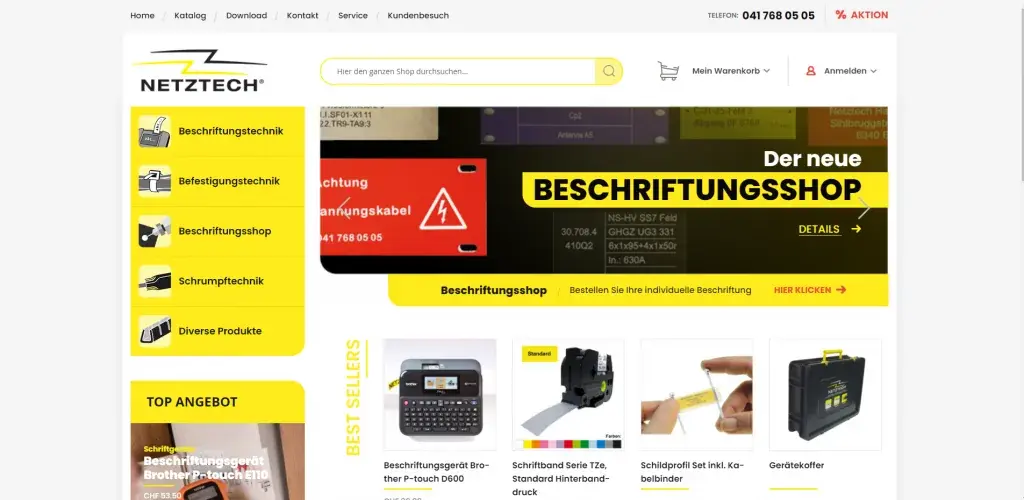
Netbase JSC delivered the migration remotely: all store data moved, 11 extensions rebuilt and a new design applied, finished in 35 working days.
Keep ReadingRelated services and solutions
 Web application development with AI built in where it converts
Netbase provides web application development for product and commerce teams that need fast, maintainable web apps and storefront front ends, with AI search, assistants and automation added where they measurably help. Since 2012 Netbase has worked with 500+ businesses across 80 countries; according to its published case studies, PrintLeo's page load improved 35% and 4over4's conversion rose 48%.
Learn More
 AI-enabled ecommerce development for merchants who outgrew templates
Netbase provides custom ecommerce development for merchants that have outgrown templates, to turn traffic into orders with less manual work, using AI for search, recommendations and catalog work where it pays. We build on WooCommerce, Magento 2, Laravel and headless stacks; 4over4, whose store gained an AI recommendation engine, reported 82% more revenue within six months.
Learn More  Multi-vendor marketplace development: vendors, catalog, payouts and AI search on one platform
A multi-vendor marketplace is a commerce platform where many independent sellers list, sell and get paid through one storefront. Netbase's marketplace solution covers vendor onboarding, a shared catalog, split payments and payouts, with AI for search, listing enrichment and fraud checks. For an EU fashion-tech marketplace, Netbase's work grew gross merchandise value (GMV) and cut vendor onboarding time.
Learn More Related insights

The right headless CMS is the one whose editorial model, hosting model and API shape match your team, not the one at the top of a ranking. Netbase compares Contentful, Strapi, Sanity and Payload on those three axes, gives decision rules that point to one option from a few answers, and names the cases where headless is the wrong call.

Content modelling before choosing a CMS: types, fields and relationships
Model your content before you shortlist a CMS: list the content types you publish, the fields each one needs and how the types link, then test the model with real entries. Netbase JSC runs this as a short workshop, because a written model turns a CMS choice from a demo contest into a fit check.

Customer, partner and employee portals: a requirement checklist
A portal requirement checklist should specify seven shared building blocks once (identity, roles, data scoping, self-service actions, content, notifications and integrations) and then add only what each portal type needs on top. Netbase recommends this split so that customer, partner and employee portals can share one platform instead of three separate builds.
Work with Netbase remotely
Every Netbase engagement is delivered remotely, so clients in any country and any industry can work with us; Netbase has worked with clients in 80 countries. Contracts and invoices are issued by Netbase JSC, and payment is made by bank transfer to Netbase JSC's company account or PayPal Business. Talk to the CEO, Huy Nguyen (David), on WhatsApp or by email.
Discuss a project
Netbase JSC helps organizations design, build, modernize, and operate digital products and AI-enabled business systems.project@netbasejsc.com
+84 937 869 689
91 Nguyen Chi Thanh, Dong Da, Hanoi, Vietnam
Get in touch
Tell us what you want to build, modernize, or operate.