

A digital transformation roadmap for mid-market companies, with decision gates and a governed AI stream
A mid-market transformation roadmap should run in five stages (mandate, baseline, design, pilot, scale), each closed by a decision gate with written evidence: continue, adjust or stop. Fund one stage at a time, tie every initiative to a business measure, and keep each stage useful alone. Run AI through the same gates, checking data readiness and human approval first.
Book a solution review See the related serviceBy Huy Nguyen (David), Founder & CEO · Updated 17 Sep 2026 · 11 min read

This template is for owners, COOs, CFOs and IT managers of mid-sized companies who need a transformation plan the board can fund and the business can absorb. It sits under our digital transformation and modernization guide, which covers what to change first and how to choose between rebuild, refactor and replatform; digital and AI transformation in emerging markets applies it where companies skip legacy stages. Here the focus is the plan itself: how to stage the work, what each decision gate checks, how to rank initiatives, where AI fits and how to keep a limited budget on the few changes that matter.
Why mid-market roadmaps need decision gates
Large enterprises can run a transformation office, absorb a failed programme and try again. Most mid-market companies cannot. They typically plan budgets a year at a time, have a handful of people who understand how the business really runs, and cannot stop operations while systems change.
A roadmap without gates turns into a list of projects that all start and few finish. A gated roadmap is different: it treats each stage as a funded bet with a question to answer, and it releases money for the next stage only when the evidence supports it. That protects the budget, and it gives the sponsor a clear moment to change course without calling the whole programme a failure.
The five-stage roadmap template
-
Mandate
Why transform, and what will count as success?
- Main outputs
- Goals, three to five business measures, a sponsor, a budget envelope for the next stage
- Gate question
- Is there an owner and a measurable goal?
-
Baseline
How do work, data and systems flow today?
- Main outputs
- Process and system map, current values of the measures, pain points ranked by cost
- Gate question
- Do we know which few problems cost most?
-
Design
What changes, and in what order?
- Main outputs
- Target processes, a ranked initiative list, the roadmap, an architecture outline
- Gate question
- Is the first initiative specified, funded and staffed?
-
Pilot
Does the change work in real operations?
- Main outputs
- One initiative live in a bounded area, measured against the baseline
- Gate question
- Did the measure move, and can the change scale?
-
Scale
How do we extend and sustain it?
- Main outputs
- Rollout plan, training, support model, the next initiatives
- Gate question
- Is the benefit holding, and what comes next?
Stages 4 and 5 repeat for each initiative. After the first cycle, the roadmap becomes a rolling plan: a new initiative enters design while the previous one scales.
Decision gates: what evidence each one needs
| Gate | Evidence required | Continue when | Adjust when | Stop when |
|---|---|---|---|---|
| After mandate | Named sponsor, written goals, agreed measures | Goals are measurable and owned | Goals are vague; rewrite them | Nobody will own the outcome |
| After baseline | Current-state map with measured values | The main cost drivers are visible | Data is missing; extend the baseline briefly | The problem is smaller than assumed |
| After design | Ranked initiatives, specification and plan for the first one | The first initiative is clear, funded and staffed | Dependencies are unresolved; resequence | No initiative justifies its cost |
| After pilot | Before-and-after measures, user feedback, run costs | The measure moved and the change is stable | The measure moved partly; fix and re-run | The measure did not move and the cause is understood |
| After scale | Adoption, measures over a full business cycle | The benefit holds; start the next initiative | Adoption lags; invest in training and support | The benefit faded; review the design |
Keep gates short and concrete: an hour with the sponsor, finance, the process owner and the technology lead, with the evidence circulated beforehand. A gate that becomes a status meeting has lost its purpose. Record each decision and its reason, so the next gate can check whether the assumptions held. When the baseline covers an ageing system, the legacy system assessment checklist lists the evidence to collect for it.
Ranking initiatives
A mid-market roadmap usually starts with more ideas than capacity. Score each candidate from 1 to 5 on five criteria:
-
Value
How much does it move a business measure agreed at the mandate?
-
Feasibility
Do we have the data, systems and people to do it now?
-
Dependency
Does it unlock other initiatives, or depend on them?
-
Risk reduction
Does it remove an operational, security or compliance risk?
-
Time to first benefit
How soon can the business see a result?
Rank by value and time to first benefit, then check dependencies. Enabling work such as data cleanup or an integration layer belongs on the roadmap only when a valued initiative needs it; otherwise it becomes a project without a customer. For AI candidates, add one check before scoring: is the data available, lawful to use and good enough?
Typical first initiatives in mid-sized companies sit where manual work meets customer impact: lead and customer handling, quoting and approvals, order processing, and reporting that currently lives in spreadsheets. Where the pain is in sales and back-office hand-offs, CRM and workflow automation is often the first initiative that pays for the next.
Measures that keep the roadmap honest
Use two kinds of measure, and report both at every gate.
Business measures show whether the transformation works: cycle time for a key process, error or rework rates, conversion, cost per order or per case, and adoption by the people who use the new process. Take the baseline values in stage 2; without them, a pilot result cannot be judged.
Delivery measures show whether the organization is getting better at changing its software. DORA, the research programme behind the most widely used software delivery metrics, describes five: change lead time, deployment frequency and failed deployment recovery time for throughput, and change fail rate and deployment rework rate for stability. A mid-market company does not need all five at once, but tracking two or three shows whether each release is getting faster and safer.
The roadmap itself should change as evidence arrives. The AWS Cloud Adoption Framework, written for cloud adoption, makes the same point: identify and prioritize opportunities, assess readiness and evolve the roadmap iteratively rather than fixing it at the start.
Trade-offs to decide early
| Choice | Option A | Option B | Mid-market default |
|---|---|---|---|
| Pace | Staged, one initiative at a time | Big-bang programme | Staged, unless a platform deadline forces a date |
| Build or buy | Custom software | Packaged product or SaaS | Buy for standard jobs; build where the process is distinctive |
| Ownership | Central programme office | Business-led initiatives | A small central owner, with business owners per initiative |
| Partners | One accountable partner | Several specialist vendors | One accountable partner, with specialists where needed |
| Scope | Whole company | One value stream first | One value stream, such as lead-to-order or order-to-cash |
| AI adoption | AI tools rolled out company-wide | AI built into one value stream | One value stream, under a company-wide AI policy |
An illustrative roadmap for a mid-market retailer
The waves below are illustrative, not a client plan:
-
Wave 1: lead-to-order
Baseline the sales process, consolidate customer records and automate quote approvals.
-
Wave 2: order-to-cash
Automate order routing and status updates, and connect the store, ERP and finance systems.
-
Wave 3: customer experience
Improve the storefront where the baseline shows customers hesitate or leave.
A real example of wave 3 is Rebelo AG, a Portuguese company founded in 1983. Netbase delivered its 3D sustainable e-commerce project, and Rebelo reported revenue up 39% in the first year, engagement up 98%, conversions in personalized segments up 53% and productivity up 25%. The results depend on that company's baseline and market. Read the Rebelo AG case, or see how Netbase approaches storefronts and order operations in retail and e-commerce.
How Netbase runs a transformation roadmap
Netbase leads with consulting and AI-enabled digital transformation, delivered through a six-step lifecycle. Stages 1 to 3 of this template sit inside its discovery and architecture planning steps; pilots and scale-up run as agile execution with outcome-based milestones the sponsor can check at each gate, followed by training, rollout and ongoing support.
Teams range from 3 to 30 people across business analysis, project management, solution architecture, development, QA and UI/UX, and work typically starts within 1 to 2 weeks after discovery. Governance runs through weekly reviews, KPI dashboards and a dedicated account manager and project manager, with the team working remote-first from Hanoi. Typical build timelines are 3 to 6 months for a mid-tier SaaS product and 4 to 6 months for a mid-sized e-commerce platform, depending on scope; these are ranges, not quotes. Digital transformation consulting turns stages 1 to 3 into a roadmap you can fund.
AI in the roadmap
Treat AI transformation as a stream inside the roadmap, not a separate programme. At the mandate, name the AI goals and write a short AI policy: approved tools, data that must not leave the company, and which outputs need human approval. The baseline adds a data readiness check. Design ranks AI use cases with the same five criteria and names the person who approves AI output. Each pilot is measured against an evaluation set as well as the business baseline, and scale adds monitoring of quality, cost and model changes. Keep a register of AI use cases with an owner for each. Netbase has also delivered retrieval-augmented knowledge assistants, document AI and MLOps pipelines for clients it does not name. Each item below states how mature it is at Netbase.
-
In delivered work
Product recommendation engine
Built for 4over4 from browsing and purchase history.
-
Available capability
AI use-case roadmaps, governed pilots and rollout
Machine learning, NLP, computer vision, generative AI and AI with IoT; beyond the 4over4 features they are not yet tied to a published case.
Roadmap checklist
- A sponsor with authority over budget and process.
- Three to five business measures with baseline values.
- A current-state map of processes, systems and data.
- A ranked initiative list with scores and dependencies.
- A written gate question and evidence list for each stage.
- A first initiative that can show a result within one budget period.
- Named business owners for each initiative.
- Training and support planned before rollout, not after.
- Two or three delivery measures tracked from the first release.
- An AI policy and a register of AI use cases with owners.
- A date for the next roadmap review.
Limitations of this template
This template comes from Netbase delivery practice, not original research. Stage lengths depend on company size, data quality and decision speed, so none are prescribed. The DORA metrics describe software delivery performance, not business value, and the AWS framework is written for cloud adoption; both are applied here in general terms. Timelines are typical ranges. The Rebelo AG results were reported for that project and depend on its baseline and market.
Plan the next step with a Netbase consultant
Frequently asked questions
Plan the next stage in detail and the rest in outline. A rolling plan reviewed at every gate is more useful than a fixed multi-year schedule.
The sponsor, finance, the process owner and the technology lead. Keep it small enough to decide.
A stopped pilot with an understood cause is a result. Record why, adjust the design or pick the next initiative.
Inside the value streams you are already changing, scored and gated like any other initiative. Start with a company-wide AI policy at the mandate and a data readiness check in the baseline, such as our enterprise AI readiness assessment; pilot AI where the data is ready and a person can review the output. An AI transformation programme runs this stream company-wide.
No. Stages 1 and 2 can start internally; outside help is most useful when the baseline shows problems that cross departments or systems.
Next step
Share your goals, the processes that cost most and your budget cycle, and we will book a solution review to draft the first two stages and their gates. You can also see the related service or browse more Netbase insights.
Work behind this guide
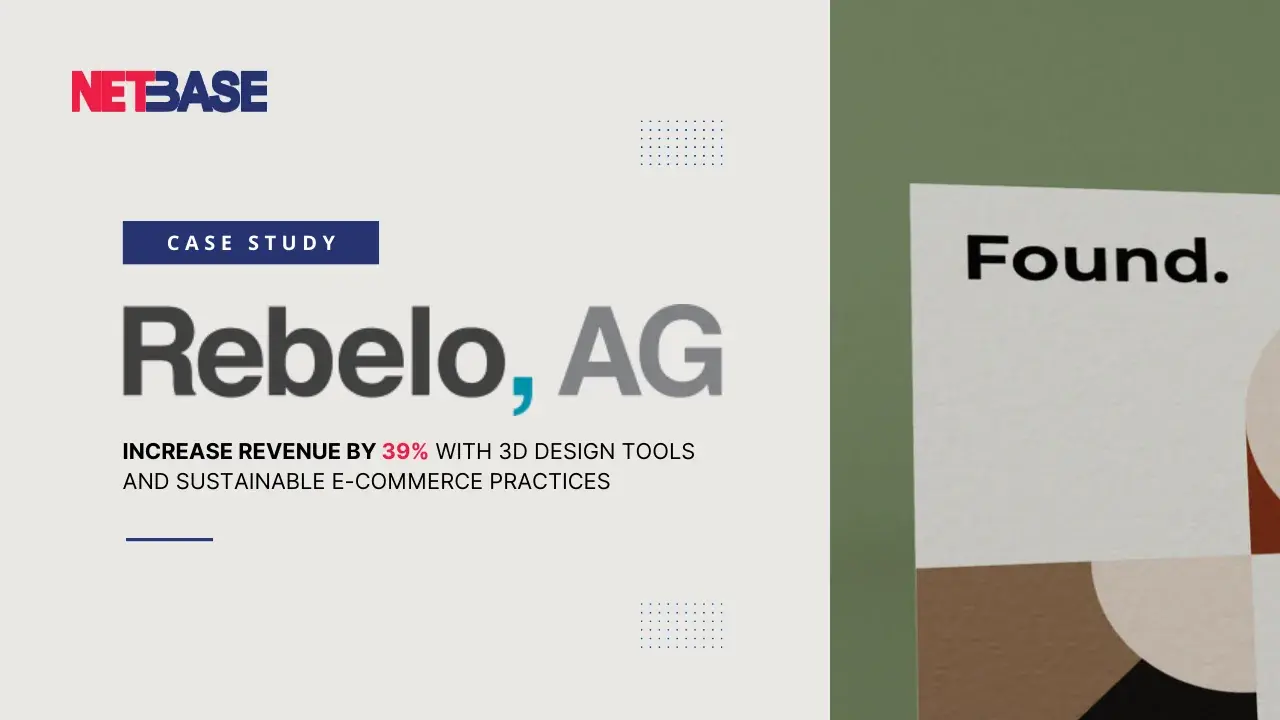
Rebelo, AG, a Portuguese offset and digital printer founded in 1983, lost orders because customers could not picture their designs on boxes and mugs.
Keep ReadingRelated services and solutions
 AI-enabled digital transformation consulting that ends in a delivery plan
Netbase provides digital transformation consulting for mid-market companies to turn operational problems into a prioritized roadmap with a delivery path, not a strategy deck. We map your workflows, systems and data, rank every change by business value and risk, including where AI can remove manual work, and hand over a plan the same team can start building.
Learn More
 CRM workflow automation with AI lead scoring, from first lead to paid invoice
CRM workflow automation connects your sales pipeline to the work behind it, so leads, proposals, approvals and invoices move on rules instead of spreadsheets and email threads, with AI scoring leads and summarising conversations. Netbase builds it for sales and operations teams in growing companies from its CRM and B2B sales engine and workflow automation toolkit, behind Cloodo Workspace.
Learn More
Discuss a project
Netbase JSC helps organizations design, build, modernize, and operate digital products and AI-enabled business systems.+84 937 869 689
91 Nguyen Chi Thanh, Dong Da, Hanoi, Vietnam
Get in touch
Tell us what you want to build, modernize, or operate.