

When AEM or Sitecore is more than you need: scale and governance thresholds for a DXP
An enterprise digital experience platform such as AEM or Sitecore is more than you need when fewer than three of six scale and governance thresholds are crossed: sites, locales, editors, personalisation data, asset reuse and vendor estate. Below that line, Netbase recommends a lighter CMS stack with written governance rules.
Book a solution review See the related solutionBy Netbase Commerce and Platform Engineering Desk · Reviewed by David (CEO) · Updated · 10 min read

This guide is for marketing, digital and IT leads who have been shown a suite proposal and must decide whether the organisation is ready for it. It sits under Netbase's web application development work and compares routes by the scale and governance work each one carries, not by vendor rankings or scores.
In this guide
- What does a digital experience platform add beyond a CMS?
- Which thresholds show you need a full suite?
- How do the four platform routes compare?
- Which questions settle the decision?
- How do you prove the choice before you sign?
- Where AI fits
- What delivery record exists, and what does not
- When is a full suite the right call?
- When should you not buy a suite?
- Alternatives and how to select them
- Limits of this guide
- Frequently asked questions
- Next step
What does a digital experience platform add beyond a CMS?
A content management system stores, edits and publishes content. A digital experience platform bundles that with more: asset management, personalisation, testing, analytics and links to the vendor's marketing tools, sold and upgraded as one suite. Adobe describes AEM as a Cloud Service as a cloud-native platform for personalised, content-led experiences, covering Sites and Assets with automated updates.
Sitecore presents its content management platform as a way to publish experiences across brands and regions, with headless delivery and real-time personalisation built in. Those capabilities are real; the question for a buyer is whether the organisation has enough sites, editors, data and process to use them.
A suite pays back when its bundled parts replace work you would otherwise build and govern yourself. When most of those parts sit unused, the organisation carries the suite's specialist skills, upgrade cycle and contract without the return.
Which thresholds show you need a full suite?
Score each of the six signals below. If fewer than three cross the threshold, start with a lighter route. If three or four cross, shortlist a suite alongside a lighter route and test both. If five or six cross, a suite belongs on the shortlist from day one.
-
Sites and brands
- A lighter stack is enough
- One to a few sites sharing one design system
- A suite starts to pay
- Many brand sites with shared components and local variations
-
Locales
- A lighter stack is enough
- A handful of languages with one translation workflow
- A suite starts to pay
- Many locales with regional teams publishing on their own schedule
-
Editors and approvals
- A lighter stack is enough
- One team, one or two approval steps
- A suite starts to pay
- Many teams, layered approvals, legal review and audit needs
-
Personalisation data
- A lighter stack is enough
- Rules by page, segment or campaign
- A suite starts to pay
- Real-time personalisation from customer profiles across channels
-
Asset volume and reuse
- A lighter stack is enough
- Media that lives with its pages
- A suite starts to pay
- Large shared libraries with rights, renditions and reuse across sites
-
Vendor estate
- A lighter stack is enough
- Separate analytics, CRM and email tools
- A suite starts to pay
- An existing commitment to the same vendor's marketing suite
Count only what is true today or funded for the next planning cycle. A roadmap slide that promises personalisation does not cross the personalisation threshold until data, owners and budget exist.
How do the four platform routes compare?
| Criterion | Single CMS or open-source multisite | Headless CMS plus separate tools | Full DXP suite |
|---|---|---|---|
| Best at | A few sites, one team, standard pages | Many channels and front ends with a shared content model | Many brands, locales and teams under one governance model |
| Governance you write | Roles, workflow and release rules on top of the CMS | Content model, workflow and how each tool connects | Configuration of a governance model that ships with the suite |
| Personalisation | Rules and segments through plugins or a separate tool | A separate personalisation or testing tool you integrate | Built in, fed by the vendor's data products |
| Skills to run it | Common web skills | Front-end and integration skills | Specialist platform skills, usually from a partner |
| Main risk | Plugin sprawl and drift between sites | Integration and ownership spread across vendors | Paying for capability the organisation does not use |
The fourth route, a custom content platform on a web framework, fits when content is a small part of a product with heavy business rules; the Laravel CMS or custom admin guide covers that choice. Open-source options also scale further than many buyers expect: both WordPress Multisite and Drupal multisite run several sites from one codebase.
Which questions settle the decision?
- Who publishes, and how many layers approve? If one team publishes with one review, workflow features of a suite will sit idle.
- Is personalisation data ready today? Without customer profiles, consent records and an owner, built-in personalisation has nothing to act on.
- How many sites share components? Shared components across many brands are where a suite's governance earns its keep.
- Which skills can you hire or keep? A platform nobody on the team can change becomes a queue of partner tickets.
- What else must it connect to? If CRM, analytics and email already come from other vendors, integration matters more than suite breadth; see wiring a CMS to CRM, marketing automation and analytics.
How do you prove the choice before you sign?
-
Inventory the estate
List every site, locale, editor group, asset library and connected tool, with an owner for each.
-
Map governance
Write who creates, reviews, approves and publishes per site and locale, and which steps need an audit trail.
-
Model the content
Define content types and shared components once; the content modelling guide gives the method.
-
Build a thin slice on the lighter route
One brand, two locales, one approval flow and one integration, used by real editors.
-
Write the gap list and decide
Record what the slice could not do, whether a suite closes each gap, and who signs the decision.
Where AI fits
AI helps around the platform choice rather than making it: drafting content type definitions from page inventories, generating translation drafts for editors to review, tagging assets and summarising a vendor's release notes before an upgrade. Engineers and editors still review every generated field, translation and permission, and AI tools are chosen per project rather than tied to one vendor.
- In delivered work
Recommendation engine
A recommendation engine delivered for 4over4's online store suggests products from browsing history and previous purchases.
- In delivered work
Content filtering into an admin queue
AI-powered content filtering that flags offensive posts into an admin moderation dashboard, for a classifieds client that is not named.
- Available capability
Editorial assistants for multi-site teams
An assistant that drafts translations or content variants from approved source content for editors to review; not yet tied to a published case.
What delivery record exists, and what does not
For a Dubai-based loyalty and rewards company whose name is not published, Netbase delivered a headless multi-store reward shop platform on Magento 2 Open Source with a Next.js front end. It runs individually branded reward shops per client programme in Arabic and English: an example of multi-brand, multi-language delivery built on open-source parts rather than a DXP suite.
For Deyar Printing & Advertising, Netbase scoped and built a bilingual Arabic and English web-to-print platform on a Laravel headless commerce foundation; its ERP and e-invoicing phase is planned, not delivered. For a classifieds founder who is not named, Netbase delivered a Laravel backend with an admin moderation dashboard.
WooCommerce, Magento 2, Laravel and headless commerce are among the platforms Netbase has delivered. Netbase's published security practices include role-based access control and multi-factor authentication for admin dashboards, and most Netbase projects are delivered on fixed-price contracts agreed after discovery. Netbase has no published AEM or Sitecore implementation record, and this guide claims no suite delivery, migration duration or cost comparison.
When is a full suite the right call?
- Five or six of the thresholds above are crossed today, not on a roadmap.
- The organisation already runs the same vendor's marketing tools and wants one contract and one data layer.
- Regional teams need to publish on their own while a central team governs components, brand and compliance.
- There is budget and a team, in-house or partner, to run the platform for years, not only to launch it.
When should you not buy a suite?
Do not buy a suite to fix a process problem: unclear ownership, missing approval rules or poor content models move with you onto any platform. Do not buy for personalisation you have no data for, or for a single marketing site. And do not sign before a thin slice on a lighter route has shown what it cannot do.
Alternatives and how to select them
- Open-source CMS with multisite. Select it when sites share one design system and one team; check plugin ownership and update policy first.
- Headless CMS plus separate tools. Select it when several front ends or apps reuse content; the headless CMS options guide compares the main products.
- Custom content platform on a web framework. Select it when content is a small part of a product with heavy business rules.
- Mid-weight suite or managed CMS. Select it when you need some suite features but not all, and compare by the same six thresholds.
Whatever the route, test accessibility against WCAG 2.2 in the thin slice: an accessible template is a platform-independent requirement, not a suite feature.
Limits of this guide
The thresholds are decision rules, not benchmarks: they do not come from a survey and carry no figures. Vendor capabilities change with each release, so check the vendor's current documentation before a decision. This guide gives no licence, build or running cost for any platform.
Plan the next step with a Netbase consultant
Frequently asked questions
No. A headless CMS stores and delivers content through APIs; a DXP adds asset management, personalisation, testing and analytics as one suite. You can assemble similar capability around a headless CMS, but you then own the integration.
Yes, both run several sites from one codebase and support translation workflows. The limit is usually governance, not software: who approves, who owns plugins and how shared components are released across sites.
Score the six thresholds together and write the result down. If fewer than three cross, run a thin slice on a lighter route first and let its gap list settle the argument.
Revisit it when a threshold changes: a new brand, new regions, a customer data programme with real owners, or a contract renewal that forces an upgrade or migration.
Next step
If you are weighing a suite proposal, send us your site, locale and editor inventory and we will reply with a proposal for a short discovery and a thin-slice plan on the lighter route.
Work behind this guide

A loyalty and rewards technology company in Dubai, United Arab Emirates, not named under a non-disclosure agreement, needed many branded reward shops on one platform.
Keep Reading
Netbase delivered a bilingual Arabic and English web-to-print platform remotely, through its Printcart division, so business and government buyers design, price and order online and every order reaches production as a checked, print-ready file.
Keep ReadingRelated services and solutions
 Web application development with AI built in where it converts
Netbase provides web application development for product and commerce teams that need fast, maintainable web apps and storefront front ends, with AI search, assistants and automation added where they measurably help. Since 2012 Netbase has worked with 500+ businesses across 80 countries; according to its published case studies, PrintLeo's page load improved 35% and 4over4's conversion rose 48%.
Learn More
 AI-enabled commerce experience solutions for print and commerce businesses
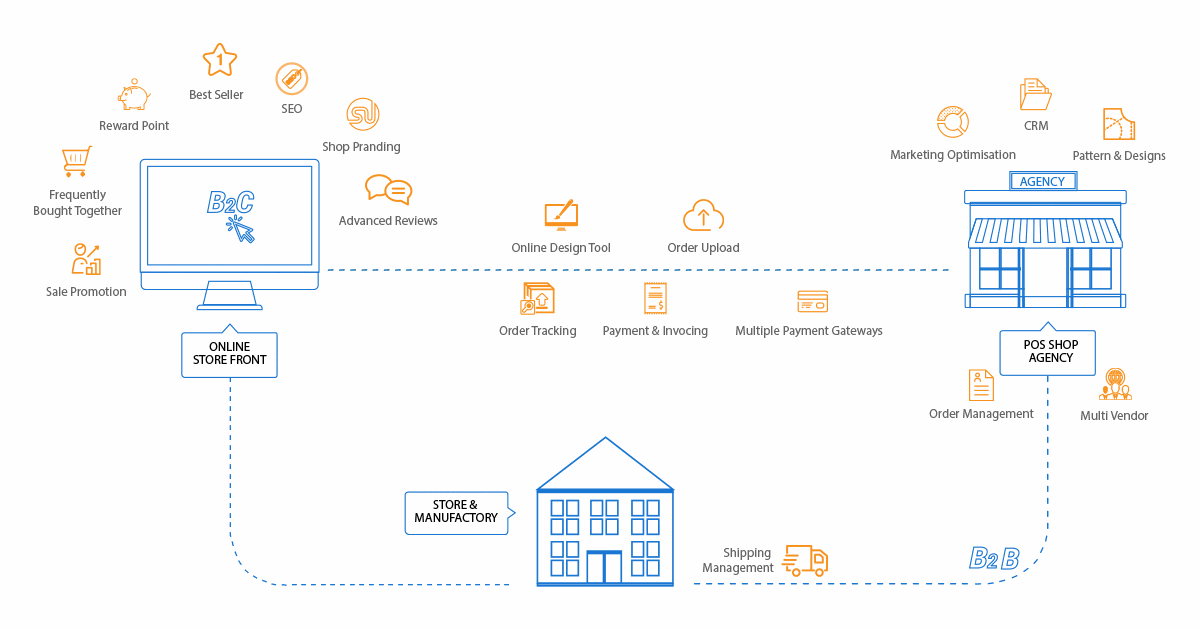
Commerce experience solutions are the Netbase family of platforms for print and commerce businesses: web-to-print ordering, multi-vendor marketplaces, product personalization and commerce operations automation, with AI for design help, search and recommendations. Each one starts from how your customers buy and how your team fulfils orders, and combines custom engineering with reusable Netbase modules.
Learn More Related insights

The right headless CMS is the one whose editorial model, hosting model and API shape match your team, not the one at the top of a ranking. Netbase compares Contentful, Strapi, Sanity and Payload on those three axes, gives decision rules that point to one option from a few answers, and names the cases where headless is the wrong call.

Content modelling before choosing a CMS: types, fields and relationships
Model your content before you shortlist a CMS: list the content types you publish, the fields each one needs and how the types link, then test the model with real entries. Netbase JSC runs this as a short workshop, because a written model turns a CMS choice from a demo contest into a fit check.

Customer, partner and employee portals: a requirement checklist
A portal requirement checklist should specify seven shared building blocks once (identity, roles, data scoping, self-service actions, content, notifications and integrations) and then add only what each portal type needs on top. Netbase recommends this split so that customer, partner and employee portals can share one platform instead of three separate builds.
Work with Netbase remotely
Every Netbase engagement is delivered remotely, so clients in any country and any industry can work with us; Netbase has worked with clients in 80 countries. Contracts and invoices are issued by Netbase JSC, and payment is made by bank transfer to Netbase JSC's company account or PayPal Business. Talk to the CEO, Huy Nguyen (David), on WhatsApp or by email.
Discuss a project
Netbase JSC helps organizations design, build, modernize, and operate digital products and AI-enabled business systems.project@netbasejsc.com
+84 937 869 689
91 Nguyen Chi Thanh, Dong Da, Hanoi, Vietnam
Get in touch
Tell us what you want to build, modernize, or operate.