

Taking over an application from another vendor: audit, stabilise, then upgrade
Taking over an application from another vendor works best in three gated phases, and this is the order Netbase follows: audit the code, access and data first, stabilise backups, deployments and monitoring next, and upgrade or replace parts only after both gates pass. Each gate ends on written exit criteria, so nothing new ships on a system nobody understands yet.
Book a solution review See legacy modernization servicesBy Netbase Delivery and Quality Desk · Reviewed by David (CEO) · Updated · 10 min read

This guide is for owners, CTOs and product leads who are replacing an agency or freelancer on a live application, often with little help from the outgoing team. It sits under Netbase's managed operations and support guide and leads into legacy modernization once the system is stable. If the outgoing vendor will cooperate, plan the handover first with the transition and knowledge-transfer plan; this guide starts where that plan ends, or where it never happened.
In this guide
- Why not start with the backlog on day one?
- What should the takeover audit cover?
- What does stable mean before any upgrade?
- The three-gate takeover plan
- How do you choose between patching, upgrading and rebuilding?
- Where AI fits
- What delivery record exists, and what does not?
- Alternatives: other routes and how to choose
- When not to run all three gates
- Limits of this guide
- Frequently asked questions
- Next step
Why not start with the backlog on day one?
The pressure after a vendor switch is to prove progress by shipping the features the old team never delivered. That is the riskiest moment to change code. The new team does not yet know how the application is built, deployed or restored, and a change that breaks production cannot be rolled back with confidence if nobody has tested a rollback.
A takeover therefore runs as three gates. Each gate has a short list of exit criteria that the buyer can check without reading code. Work on the next gate starts only when the current one is signed off, except for emergency fixes, which go through the same review and are logged.
What should the takeover audit cover?
The audit answers one question: can this application be changed safely, and what must be fixed before it can? It is evidence-based, not an opinion on the previous vendor. Use the scorecard below; each area gets one of three ratings (sound, fix before change, fix before go-on) and the evidence behind it.
-
Ownership and access
- Evidence to ask for
- Repository, hosting, domain, database, app store and third-party accounts in the client's name
- Red flag
- Any account only the old vendor can open
-
Build and deploy
- Evidence to ask for
- A clean build from the repository and a documented deploy path
- Red flag
- Production differs from the repository, or deploys are manual copies
-
Data and backups
- Evidence to ask for
- Backup schedule, retention and a dated restore test
- Red flag
- Backups exist but nobody has restored one
-
Security exposure
- Evidence to ask for
- Shared credentials, admin access, known vulnerabilities, unusual files
- Red flag
- Old team members still hold live credentials
-
Dependencies and runtimes
- Evidence to ask for
- Framework, language and library versions against their support dates
- Red flag
- Unsupported runtime or components with known vulnerabilities
-
Tests
- Evidence to ask for
- Automated tests on the paths that earn money
- Red flag
- No tests on checkout, sign-in or billing
-
Monitoring
- Evidence to ask for
- Uptime, error and performance alerts with an owner
- Red flag
- Failures are reported by customers first
The dependency row matters more than it looks. The OWASP Top 10 lists vulnerable and outdated components as a risk category, starting with not knowing which versions you run. For the deeper look at value and technical health, the legacy system assessment checklist covers ten areas in more detail.
A short, independent audit is worth buying before any longer contract. OutsourcingVN, a Netbase brand, offers a technical audit sprint: a timeboxed technical, security or AI audit with a decision output.
Audit exit criteria: every account is in the client's name and old credentials are rotated; the application builds and deploys from the repository; the scorecard is written down with a rating and the evidence for each area.
What does stable mean before any upgrade?
Stable means the team can run the application through a bad day without guessing. Four things show it. Backups are proven by a restore, not by a schedule; the Google SRE chapter on data integrity makes the point that what people need is restores, not backups. Monitoring covers latency, traffic, errors and saturation, with alerts that reach a named person. Deploys run the same way every time and can be rolled back. And the critical paths have tests that run before each release.
Stabilisation also writes things down as it goes: the runbook for the top failures, the architecture sketch and the access list. The minimum documentation set is a good target for what to produce.
Stabilise exit criteria: a restore has been tested and dated; alerts reach a named owner; a release and a rollback have been done through the documented path; the critical paths have tests; the open security items rated "fix before change" are closed.
The three-gate takeover plan
-
Secure ownership
Move every account into the client's name, rotate credentials the old team held and freeze a reference copy of code and data before anything changes.
-
Audit with evidence
Fill the scorecard from the repository, the servers and the accounts, and agree the ratings with the client in a written report.
-
Stabilise the run
Prove restores, set up monitoring and alerts, make deploys repeatable, add tests on the critical paths and close the urgent security items.
-
Decide the route
Use the upgrade decision below to choose between patching, upgrading in place, replacing a part or rebuilding, per component.
-
Upgrade in small releases
Change one component at a time behind the tests and monitoring from step 3, and keep a rollback for each release.
-
Agree the ongoing scope
Put the support scope, response targets and reporting in the contract so the application does not drift back to where it started.
How do you choose between patching, upgrading and rebuilding?
| Route | When it fits | Main risk | Do not choose it when |
|---|---|---|---|
| Keep and patch | Supported stack, sound structure, few changes planned | Hidden debt grows if patching never ends | The runtime or framework is out of support |
| Upgrade in place | Same product, older framework or runtime version | Breaking changes in plugins and integrations | There are no tests on the critical paths yet |
| Replace a part | One module blocks change while the rest is sound | Two systems to run during the switch | The interfaces between modules are unknown |
| Rebuild | The audit shows the core cannot be changed safely | Long period with no new value and lost behaviour | The reason is only that the code looks unfamiliar |
Replacing a part usually follows the pattern Martin Fowler calls the strangler fig application: a new component grows around the old one and takes over its work step by step until the old part can be switched off. It keeps the business running while the riskiest piece is replaced. For runtimes near end of life, the guide on end-of-life PHP, .NET and Java versions covers the upgrade paths.
A rebuild is rarely the right first answer after a takeover. It throws away behaviour the business depends on but nobody wrote down, and the audit is usually the first time anyone has seen that behaviour clearly.
Where AI fits
AI speeds up the reading part of a takeover. A model can summarise an unfamiliar codebase module by module, list dependencies and their versions, draft the first runbook entries from logs and deploy scripts, and propose tests that describe how the current code behaves. Engineers still verify every summary against the running system, review every change before it ships and decide each rating on the scorecard. AI tools work on a copy of the code and get no production credentials. Netbase works with the major commercial and open-source AI tools and models, chosen per project.
- Available capability
AI-assisted code reading under human review
AI-drafted summaries, runbooks and tests pass the same code review as any other change, and an engineer signs off each audit rating; not yet tied to a published takeover case.
What delivery record exists, and what does not?
Netbase runs, maintains and upgrades what it builds, remotely and alongside the client's in-house team, under an agreed support scope, and response targets are set per contract. Ongoing support and co-building is the last step of its six-step delivery lifecycle, and governance runs on weekly reviews, KPI dashboards and a dedicated account manager and project manager. Source code is managed in GitHub.
For an existing client store, Netbase scoped a three-phase recovery of a compromised Magento site: investigation and a security scan with an infected-file report and a recovery plan, then cleaning and system recovery, then file restore, recoding and hardening with security patches applied. Recovery depends on the damage and is never guaranteed. Netbase also delivered a Magento 1 to Magento 2 migration for Netztech.
Security work follows Netbase's practices, including secure code review and version control, role-based access control, MFA for admin dashboards and vulnerability scanning; Netbase holds ISO 27001 certification and a SOC 2 Type II attestation for its own operations. Most Netbase projects are delivered on fixed-price contracts; milestone-based, monthly team retainer and KPI-linked models are also offered.
What does not exist: no published client case of a takeover from another vendor, and no figure for defects found, downtime avoided or time to stabilise.
Alternatives: other routes and how to choose
- Bring the work in-house. Best when the application is core to your product and you can hire people who will stay; the same three gates still apply.
- Return to the original vendor with a new contract. Best when the problem was scope or governance, not skill, and access is still shared.
- Shared operations with your own team. Best when you have engineers who should keep the product knowledge; see working alongside an in-house team.
- A full takeover by a new partner. Best when nobody in-house knows the system; ask for the audit as a separate first step and for application security assurance if exposure is the main worry.
Selection criteria: who will hold the knowledge in three years, whether the old vendor still controls any account, how much risk the business can take during the switch, and whether you can review a partner's work each week.
When not to run all three gates
- The application will be retired within months. Secure ownership and backups, then keep it running as it is; an upgrade will not pay back.
- A cooperative handover is still possible. Run the staged transition with the outgoing team first and use the audit to confirm what they handed over.
Limits of this guide
- The scorecard is a default for one business application; regulated systems may need extra checks set by your compliance owner.
- No figure in this guide comes from a Netbase client case.
Plan the next step with a Netbase consultant
Frequently asked questions
Yes, if the contract gives you the rights to the code and the accounts are in your name. Recover access to the repository, hosting and domain first, then rebuild from what runs in production if the repository is missing or out of date.
Usually not as a first step. Audit and stabilise it, then rebuild only the parts the audit shows cannot be changed safely, because a full rebuild loses behaviour that nobody wrote down.
Ask for the audit as a separate step with a written scorecard, the exit criteria for stabilisation, and how they will prove restores and rollbacks before they change features.
Next step
Tell us what you inherited and what the old vendor left behind, and we will propose an audit as the first step: book a solution review.
Work behind this guide
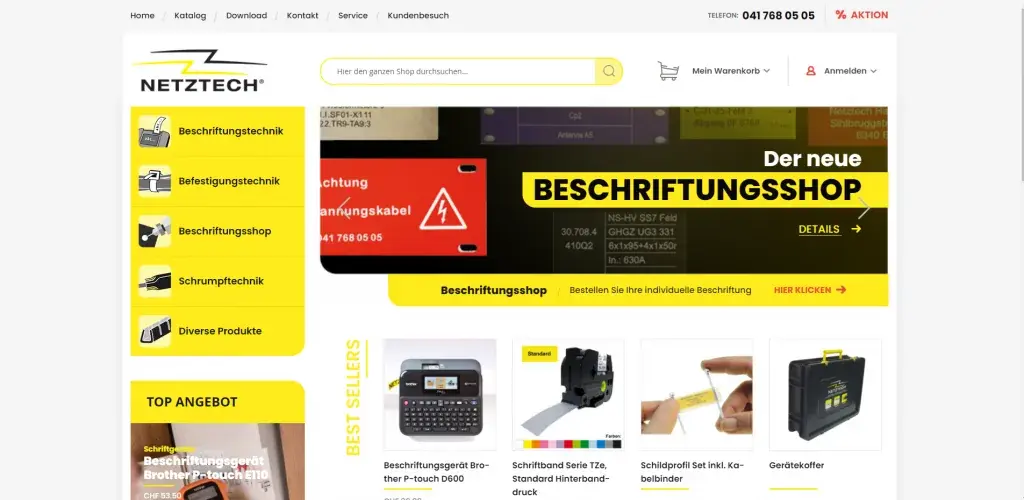
Netztech Handels AG, a Swiss supplier of labeling, fastening and shrink technology in Baar, needed its busy online store moved from Magento 1 Community Edition to Magento 2 Commerce.
Keep Reading
A full-service print shop, not named and in a country the record does not state, wanted a ready-made WordPress print store turned into the site it had designed.
Keep ReadingRelated services and solutions
 AI-assisted legacy modernization that keeps your orders and data safe
Netbase provides legacy application modernization services for commerce and operations teams to move ageing platforms, such as Magento 1 stores, onto supported technology without losing orders, customers or data. AI speeds up code analysis and data mapping; every migration runs on a written, human-approved plan with rehearsal, staged cut-over and rollback, proven by Netztech's move to Magento 2.
Learn More
 Application security assurance for web, SaaS and AI features
Netbase provides application security testing for product and engineering leaders to find and fix vulnerabilities before release, including in AI features. We review code with AI-assisted triage, scan dependencies and test running applications, then rank findings and retest fixes. Netbase's own alignment with ISO 27001 and SOC 2 Type II covers Netbase's operations, never your application.
Learn More  Application maintenance and support for live web, mobile and business software
Netbase maintains and supports software that is already live: web platforms, online stores, mobile apps, ERP and CRM systems and internal tools, including software another vendor built. We take it over after a code and environment review, then fix defects, keep frameworks current, monitor it, make small changes and report monthly, under service levels agreed in your contract.
Learn More  SaaS product accelerator: launch an AI-ready SaaS on proven Netbase modules
A SaaS product accelerator is a set of reusable Netbase modules for accounts, billing, roles and integrations that helps founders and product teams launch subscription software faster, with room for in-product AI from the first release. Reusing these modules can shorten development time, and the approach is proven on Printcart, Netbase's own web-to-print SaaS.
Learn More Related insights

A remote partner shares operations without taking over when the in-house team keeps the decisions (priorities, release approval, production access and incident command) and the partner carries written duties such as alert watch, patching and agreed fixes. Netbase works this way alongside client teams, under an agreed support scope with response targets set per contract.
Work with Netbase remotely
Every Netbase engagement is delivered remotely, so clients in any country and any industry can work with us; Netbase has worked with clients in 80 countries. Contracts and invoices are issued by Netbase JSC, and payment is made by bank transfer to Netbase JSC's company account or PayPal Business. Talk to the CEO, Huy Nguyen (David), on WhatsApp or by email.
Discuss a project
Netbase JSC helps organizations design, build, modernize, and operate digital products and AI-enabled business systems.project@netbasejsc.com
+84 937 869 689
91 Nguyen Chi Thanh, Dong Da, Hanoi, Vietnam
Get in touch
Tell us what you want to build, modernize, or operate.